
The 3-Day Aligned Action Experiment
A simple practice to move from overwhelm/resistance to clear action.
We often use pressure, accountability, deadlines, fear, desire, excitement, or external expectations as our "start button."
These can supply activation energy but may eventually become exhausting or stop working.
Let's see what happens when we approach that moment differently.
Thank you for participating.
Before trying the experiment:
If you feel unable to settle or tired, you may find this short Movement in Stillness practice helpful to restore energy and a sense of ease. It helps shift the autonomic nervous system from a sympathetic state (stress) to a parasympathetic state (healing and recovery).
You can watch the 2-minute video below:
For the Next 3 Days
Choose a real situation from your daily life where you've been delaying, avoiding, or struggling to start.
Examples: Writing content. Working on a project. Responding to an important email. Exercising. Any task that feels important but difficult to begin.
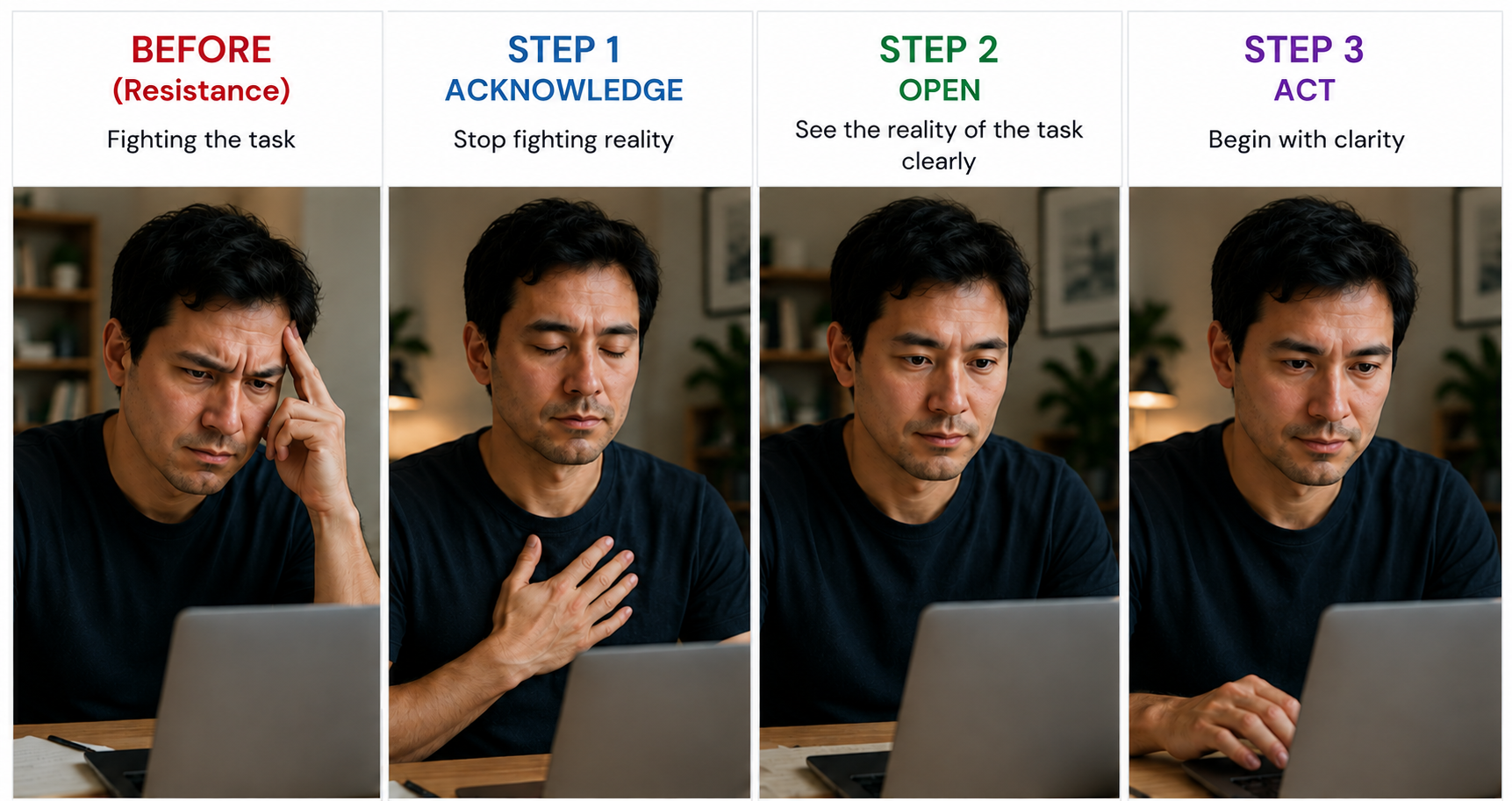
When resistance appears, apply the following steps:
Step 1. ACKNOWLEDGE (what is)
Notice your current state/situation and allow it to be here.
You may feel: Anxiety, resistance, fatigue, confusion, pressure, restlessness.
You do not need to become calm.
Just stop creating a second layer of struggle on top of what is already present. Meet your current state the way a good parent would meet an anxious or excited child.
Step 2. OPEN (test the Intelligence within)
OPEN, at its core: I don't know. Let me see.
Don't rush to produce an answer from what you already know (thinking, searching from your memory bank).
Open your attention to the actual situation: Look. Listen. Feel. Notice.
Let the question you have answer itself.
So:
Bring the task or the situation in front of you.
Open your awareness to the objects involved in the task. For example: The screen, the document, the person in front of you, or whatever relevant.
Simply look at what relates to the task. See what naturally emerges. (If you have an intention or desire, you may narrow the reality you see). For this moment, don't worry about finishing or getting the result right.
Clarity before effort is the principle here. And clarity comes from the clear space of seeing you can access at this moment.
* If you’ve tried and are still so caught up in thought or emotion, you can have support by scrolling down to “Meet Your Presence Ball”.
Step 3. ACT (small & full)
Take action on what you clearly see.
Or, you may ask: “What is a right thing I can do to this task/situation right now?”
Examples:
Open the document and just read it.
Write down an insight.
Create a rough list or draft (perfect it later).
Relax and meet this act fully.
The key is to experience the small act completely, cleanly (meaning, just focusing on the actual step right now)
The mantra is: “I don't care about the final result for now; I only care about making this micro-step clean.”
(You may want to slow down a bit at the beginning. If your goal is to finish the act, you may already miss it. Also, don't look for the perfect action. When you’re there fully with it, something in you will know whether you do the right thing.)
Savor the completion: When it is done, pause for a moment. Feel the brief wave of satisfaction when a small task is done fully. Anchoring the feeling of fulfillment.
A Chain of Small, Clean, Continuous Acts
If one act helped, don't stop there
One complete act helps you taste: Open and Cross the Threshold.
But if you like to experience the real effect of a chain of small, clean, continuous acts (in terms of energy, result, and the sense of satisfaction):
Just gently rest in the field of seeing - see what comes up.
Or, ask again: “What is the next act the task requires?” - then do it fully.
Whenever you lose the thread, simply return to seeing. Frequently acknowledging something good or enjoyable in what you do also helps sustain the continuous act.
A chain of complete acts is like driving: your consciousness sticks to the road in front, and you enjoy something presented there. The next stretch reveals itself as you move. No need to hold the whole journey in mind. Just keep your awareness gently open to the objects involved in the task.
When awareness continuously applies to an object/task, both awareness (clarity/energy) and result increase EXPONENTIALLY.
Apply this to an issue you want a breakthrough for a month and see the change for yourself.

Just tried it?
I'd love to hear what happened—whether it helped or not.
It takes about 2–3 minutes: [Feedback Form]
Optional Supports
Support for step 2:
Meet Your Presence Ball
The Presence Ball is a metaphorical way to tangibly describe your field of awareness at a certain moment (some people call it: the Center, the Zone, the Vortex).
It helps you manage your attention intentionally and focus on what matters more easily.
Most importantly, entering the Presence Ball is a way to stay present more effortlessly. This helps you disentangle from unnecessary thoughts and reduce your emotional intensity.
So, if "Open" feels impossible to you:
Briefly see yourself already out of the problem or in the desired scenario. Or, simply notice what’s a good thing you’re having/experiencing.
This will get you out of the emotional trap created by one possibility or interpretation. Anchoring in that feeling for a few seconds.
Then try this awareness-opening exercise.
You can call it: Entering the Presence Ball.
It acts as Attentional Scope Widening or an Embodied Presence Doorway, which directly lowers nervous system hyper-arousal. The body is softened.
Pause. Take 3 deep breaths 1-2-3.
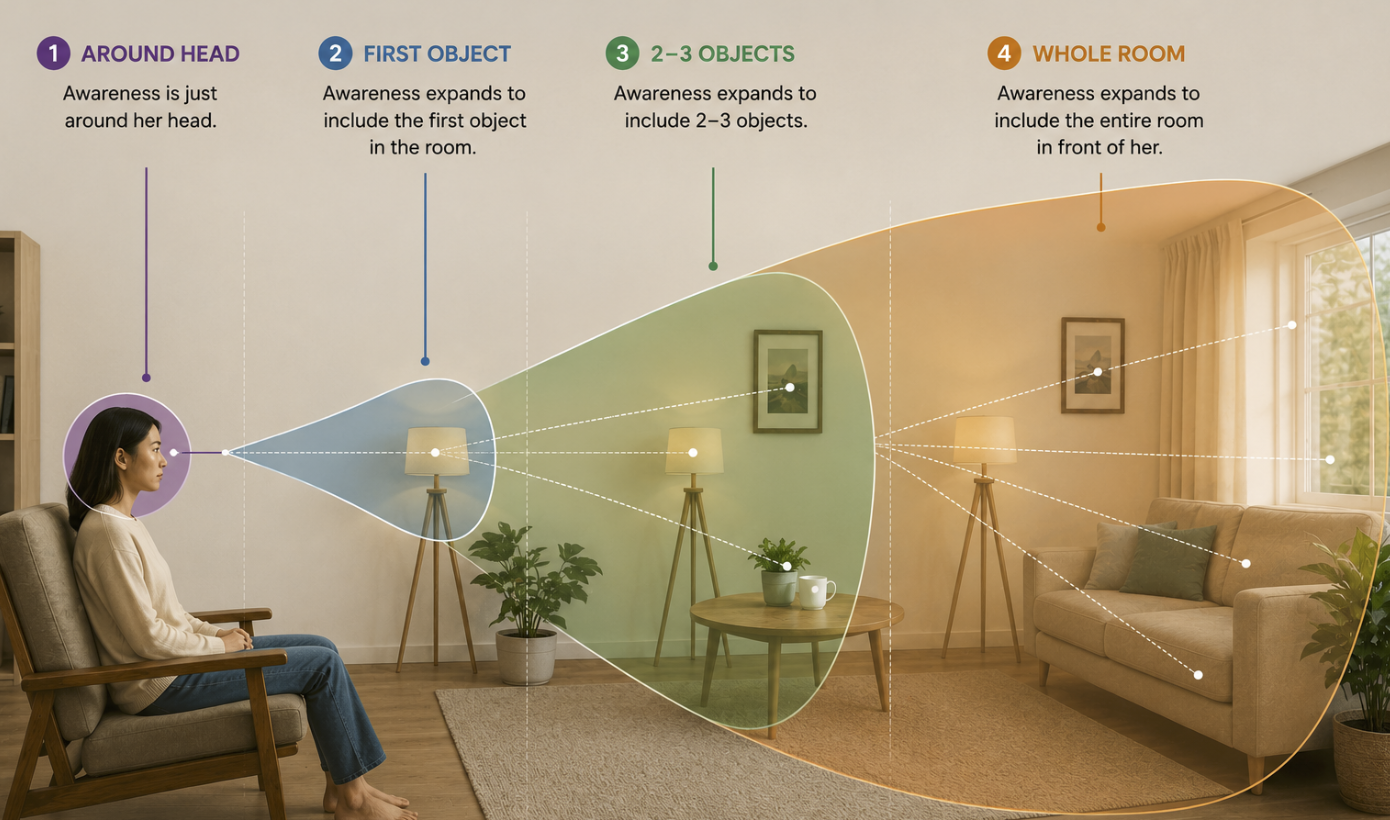
Look at one object in the room.
Then, widen your awareness to include two or three more objects.
Continue expanding until your awareness includes a bigger part of the room in front. Rest in the field of seeing (the Presence Ball), not focusing on any objects.
Gently notice that your thoughts are now part of a larger field of experience: It may feel as if your thoughts or emotions have gone from occupying nearly 100% of your experience to just 5–10%. Confusion is there, Clarity is there also. (And you can act from either at any moment)
Anchor there for about a minute, then return to your work.
The picture below describes the change in your awareness field when it expands.
If you prefer to close your eyes: Here are two effective ways to opening the field of awareness, or entering the Presence Ball.

Your Presence Ball listens to all sounds
- Close your eyes
- Listen to sounds surrounding you. Spot as many sounds as you can from all directions, (not focusing on any particular sound).
- Do you notice there is the field that listens- the field that holds all sounds?
What is the quality of that field?
(silent vs. chaotic? light vs. heavy? expanding vs. contracting? clear vs. confusing?)

Your Presence Ball anchors in the lower body
- Close your eyes
- Place your attention around your belly or the lower part of your body - wherever you feel comfortable.
- Let the Presence Ball embrace your body for a moment.
How do you feel?

Now, bring the Presence Ball to work
Let it gently rest on the screen.
Not yet?
If you tried all of those above and still get stuck in a story, this may help:
Pick a simple activity, such as tea making or cleaning.
Do the activity in this way: try to use your attention to move the object first, then use your hand to support your attention.
(It’s as if the stream of your awareness gently moves the object a split second before your physical hand actually touches it.)
How do you feel?
You can watch the tea-making video below.
Support for step 3:
How to experience a small act fully but not effortful?
You rest in the field of expanding awareness (Presence Ball) that covers the objects of your activity.
As you act, you may notice two aspects of your experience:
Thoughts, emotions, and impulses come and go.
At the same time, there is a quiet field of relaxed observing that continues noticing the task in front of you.
It’s often easier to experience the two fields (movement and stillness) with physical act, such as running. You may realize that it’s the stillness aspect that supports/stabilizes the movement.
You can try this small experiment: when the body is tired or feels lazy, you ask it to run or do something, the mind may resist. But if you just rest in the field that covers the action (the Presence Ball) and move, the body’s suddenly able to do it.
The two images below:
Running while thinking - the body easily gets exhausted.
Vs. running while resting in the Presence Ball - sustainable energy for the body and a clear mind.

How to Engage the Chain of Small, Continuous Acts More Effortlessly
Don’t make each act merely a means to an end. When your attention is fixed on a distant result, your mind and the act become separated. Attention repeatedly leaves the activity and goes toward the future reward. So less of your energy is available to the doing. Thus, the present act can feel like a burden you must get through.
Instead, enter the act itself. Ask: What is useful, interesting, meaningful, or enjoyable here? When you find value in the doing, your attention comes fully into the act—and the act itself can begin to generate energy. Whatever you repeatedly find reward in, you tend to keep developing.
For example, running is a chain of small, continuous acts. You can enjoy each in-breath with each stride, as the in-breath gives more energy to the body. Your mind now has an anchor in the run and the running energy keeps growing. After a while, you may notice that your body feels lighter, your movement becomes more natural, and you find yourself wanting to continue.
The goal gives direction; the act gives you energy to continue.
The result is just our energy flows into the action. The more fully your energy enters the action, the better the result can become.
The Science Behind the Practice
Aligned Action brings together several simple practices that have individually been studied in research on attention, stress regulation, emotion, cognition, and behavior.
What remains less established is what happens when these elements are deliberately combined into a single sequence for a specific moment: when someone knows what they want to do but feels resistance to beginning.
The experiment is designed to explore that question.
ACKNOWLEDGE:
When you fight or fix an internal thought or emotion, you may create an additional control task on top of the original task. That can increase cognitive load, maintain attention on the unwanted experience, and thus make wanted behavior harder.
Acceptance-based approaches allow the experience to be present. Acknowledge what is present without trying to immediately suppress, avoid, or fix it. This reduces struggle with the internal experience. The important mechanism is: The feeling can remain, while behavior becomes possible again.
OPEN:
High stress and cognitive overload induce foveal (tunnel) vision. This state triggers the sympathetic nervous system (fight-or-flight), spiking cortisol and shutting down the rational prefrontal cortex.
Intentionally widening your visual field to take in the periphery activates the vagus nerve. This sends a rapid signal of safety to the brainstem, dropping the heart rate and reducing the acute performance anxiety that causes avoidance.
Procrastination in high performers is often characterized by dense "internal noise"—mental scanning, over-planning, and predicting failure. This over-activates the Default Mode Network, leaving the brain trapped in rumination.
By shifting load from internal thought to external space, you free up the cognitive bandwidth required to simply begin.
The "Presence Ball" exercise is actually a highly effective way to regulate the autonomic nervous system—shifting a person from a sympathetic state (stress) to a parasympathetic state (healing and recovery) using wide-angle visual field cues.
ACT (a micro-step):
Clear, micro steps bypass brain threat-detection.
The human brain is a prediction engine. When an innovator looks at a massive, complex goal (like Writing the entire research grant), the amygdala perceives the sheer magnitude and risk of failure as an existential threat, triggering emotional avoidance.
Bring the scope down to a physical micro-action (like Read the first sentence) keeps the task under the amygdala's radar. Execution of that single tiny action triggers a micro-dose of dermal dopamine, shifting the brain from a state of threat to a state of reward. Once momentum starts, cognitive friction dissolves.
About The Creator
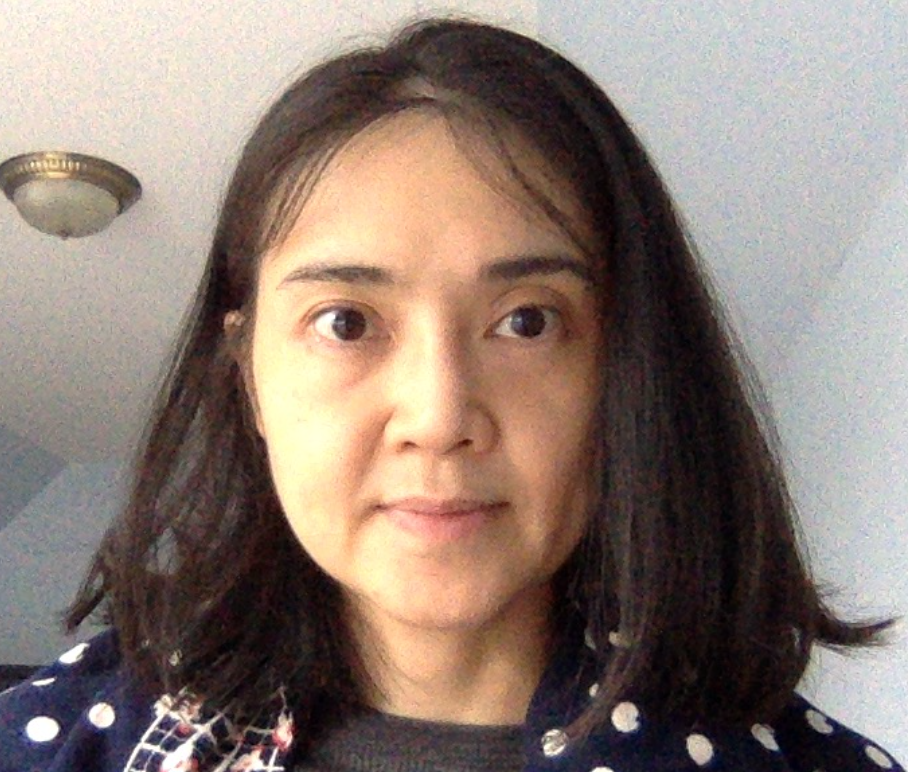
Linh Nguyen
Developer of the Aligned Action Practice
For years, Linh worked in media and entrepreneurship—and experienced firsthand the cognitive exhaustion, stress, and burnout that comes from forcing ambitious goals without a stable energetic foundation.
Her search for a more sustainable way of working led her to spend three years living and practicing full-time at a Zen center in Cambridge, Massachusetts, while also studying neuroscience and contemplative practices.
Over time, she began exploring a simple question:
Can we learn to take meaningful action without first having to force ourselves into the “right” internal state?
That question eventually led to the development of Aligned Action—a practice that combines acceptance of the current state, expanded awareness, and one small, complete action.
Linh is now testing the practice with real people to understand when it helps, for whom it works best, and whether it can reliably make the transition from intention to clear action easier.