
The Aligned Action Practice
Moving from resistance (force) to clear action (flow)
What Is Aligned Action?
Aligned Action is acting without forcing yourself, even when you don’t want to act.
Aligned Action is acting by relying on the presence energy rather than motivation, emotion, or willpower.
- Yes, I want it. But how?
It’s simple. There is a tool for effortless Aligned Action. You just get used to using the tool.
The tool is:
The Presence “Ball”
The Presence Ball is the presence taking a usable scope in action. It’s the appropriate field of awareness (or Center) for the action you're taking. It allows you to stay connected with reality without becoming completely absorbed in thought, emotion, or pressure.
The Presence has no boundary.
The Ball does. The boundary of the Ball is the shape Presence takes as you engage with a particular moment or activity.
- So what is the use of Presence Ball?
The Presence Ball helps you stay present more effortlessly while acting.
It allows you to remain in a focused field of Presence rather than becoming completely absorbed in thought or emotion. You can think, plan, or interact while remaining rooted in the field of Presence.
The field of Presence is your Center from which you work, so you’re not losing yourself in what you're engaging with. Your energy is preserved.
Let’s look at an example: Looking through the mind vs. Looking through the Presence Ball:
Looking through the mind: energy goes outward and dissipates. You feel exhausted.
Or, your energy entangles with objects: you lose the center and clarity.
However, looking through the Presence Ball: The Ball lets you include the object without abandoning the field (center) you're in.
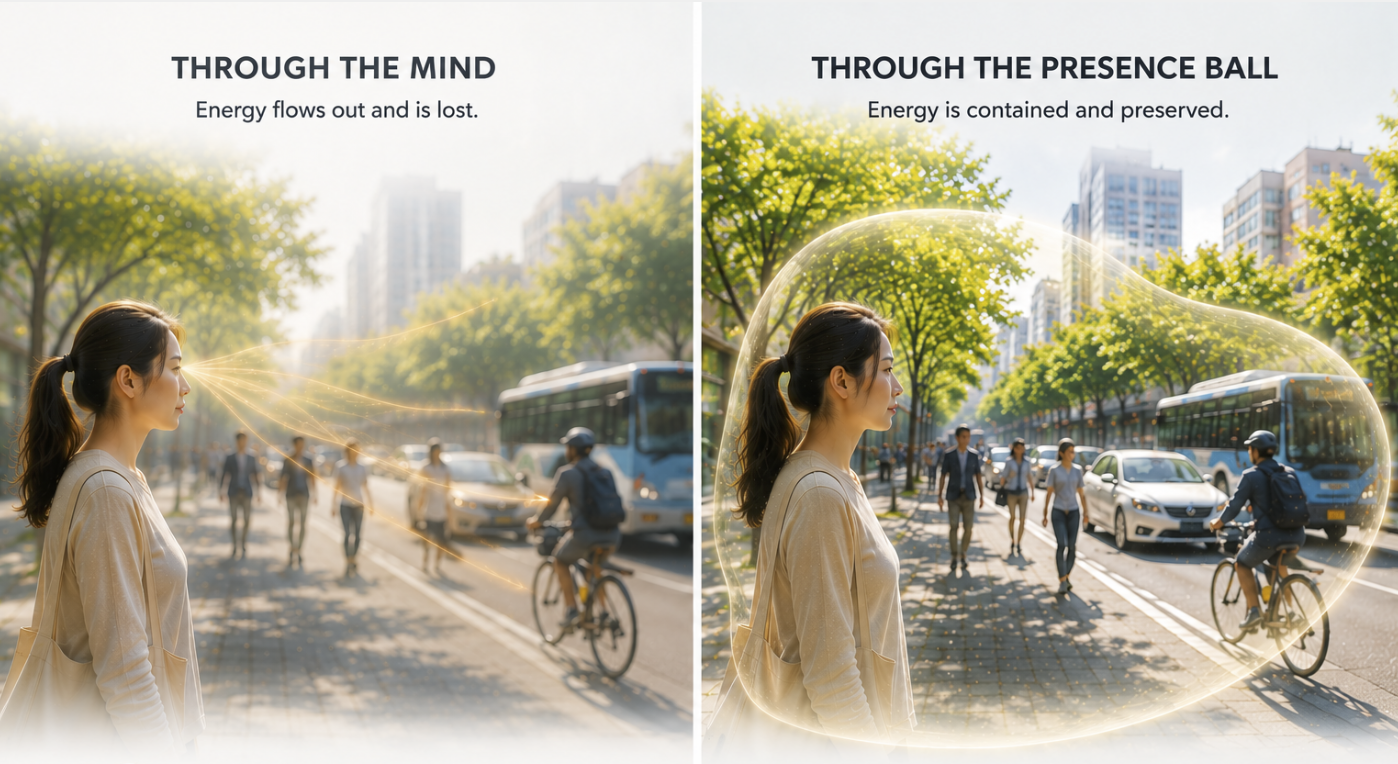
- Got it. The Presence Ball give you a center, which preserves energy and clarity while acting. So how to get into the Ball?
Getting Into the Presence Ball:
You don't create the Ball. The Presence is already here. You just enter it.
To enter the Ball, first stop fighting whatever is happening inside you. Then gently open your awareness to the reality around you—your body, the space, the objects, and whatever the activity requires.
Let your awareness take the shape of what the moment requires.
The Ball moves and reshapes itself as you act, as shown in the photo below.

So, the Presence Ball is a general human capability; Aligned Action is one of its most practical consequences.
You can get into the Presence Ball and experience an activity differently:
In Leadership: Lead without Losing Your Center
In Execution: Work without Forcing Yourself
In Creativity: Create in the Field of Not Knowing
In Entrepreneurship: Keep Moving When You Don't Know the Outcome
Or, in Running: Run with Sustainable Energy and Clear Mind
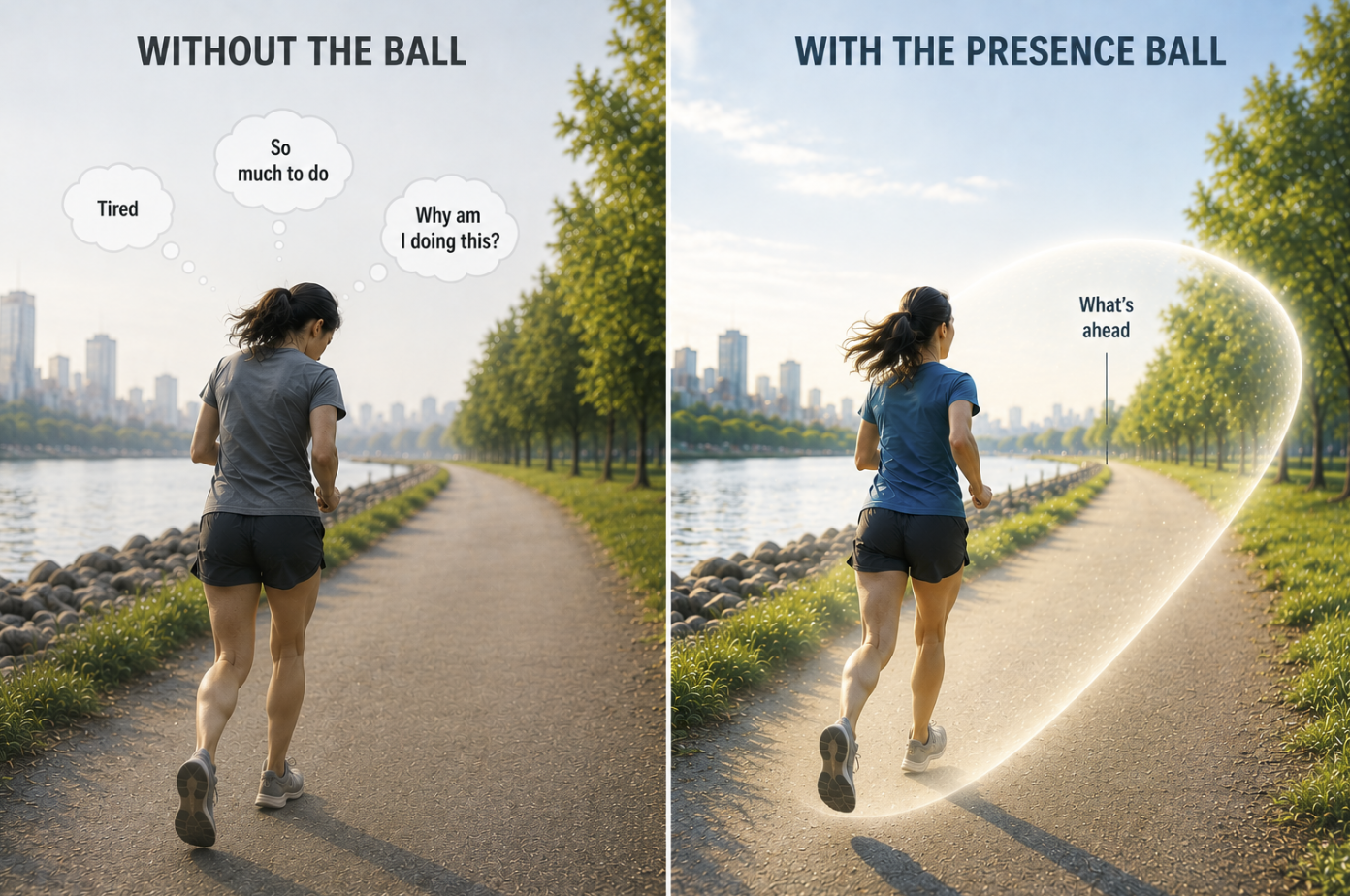
Why is opening awareness (or entering Presence Ball) so important in Aligned Action?
Because whatever occupies the center of our awareness begins to organize our experience. When awareness contracts around fear, guilt, someone else's expectations, or a distraction, we can become trapped inside its world—and our original intention disappears from view. We’re sidetracked from our path.
Opening awareness creates space again. The disturbing thought or emotion doesn't have to disappear; it simply becomes one part of a larger field. From that wider awareness or clear space, we can see the facts, remember what matters to us, and reconnect with our purpose.
Then, instead of being driven by whatever has captured our attention, we can use the energy available in the present moment to take one clean action in the direction we choose. We return to our path.
If you want to dig deeper into:
The Deeper Truth
“How do I manage my life?” It's a question many of us ask when work, responsibilities, and uncertainty begin to feel overwhelming.
The answer may be much simpler than we think: we just need to manage this right step well by meeting this moment fully. Not in years, not in months, and even not in days. Only in this moment.
Think of crossing a street without traffic lights. You don't try to cross the entire street in one step. You look to the left and cross one half. Then you look to the right and finish the other. Each step naturally reveals the next. The whole crossing happens smoothly because each part receives your full attention.
Yet this is rarely how we live.
We wash a dish while thinking about work. We write one email while carrying tomorrow's deadline. At first, nothing seems wrong. But when this becomes our habitual way of living, our attention is divided between what we are doing and what we are mentally carrying.
Imagine trying to cross an entire street all at once instead of one side at a time. A simple act suddenly becomes confusing and even dangerous. In the same way, when we mentally try to live several moments at once, we make life far more complicated than it actually is. Small errors become bigger mistakes. Stress grows. Decisions become less clear. Eventually, overwhelm begins to feel like a normal part of life.
Aligned Action starts with a small. complete act—each “frame” of the action is complete in itself. The act is no longer divided between what you are doing and what you are mentally carrying. Overwhelm begins to lose its grip. Clarity often appears—not because the whole problem has been solved, but because the next step becomes visible. Presence expresses itself naturally through one small, complete act.
A complete act happens when your attention naturally comes home to what you're doing (rested, full attention without effort). Such an act has its transformative power, as it changes the quality of your consciousness.
You have already experienced moments like this: times when action felt clear, effortless, or deeply engaging. Aligned Action is not about creating a new state. It helps you recognize that state and return to it more reliably.
And this is the most important part of the practice: Returning. You do not need to practice perfectly. Every time you notice your attention has drifted into the future or become lost in thought, simply return to what is here. Simply return again and again.
Once you experience a chain of small, clean, continuous acts, you may realize a doorway to something transformative – that’s the deepest meaning of Aligned Action. But only you can discover it for yourself. And the practice is the doorway.
Most of us have discovered a remarkable energy while absorbed in music, writing, walking, creating, or caring for someone. In those moments, action seems to carry itself. We often think the activity created that experience. What if the activity simply helped us recognize an energy field that was already available?
So: Aligned Action is the practice of meeting this moment clearly through one small, complete act. If you stay with the practice, you may discover that the greatest change is not in what you accomplish, but in the source from which your actions begin to arise.
Aligned Action helps you stop waiting for the "right feeling" before taking the next act.
Why a Complete Act Matters?
Careless acts tend to create unnecessary work for the future. Every incomplete act asks for another act.
You send a careless email. You need another email to clarify or even apologize (with much thinking in between).
You ignore one small issue. Later it becomes a larger problem.
You hurriedly put something down. Later you have to spend much time looking for it.
A complete act restores your contact with reality. When you fully meet one small, complete act, the psychological burden (worry, desire, expectation) of the problem falls away, leaving only the part that reality is actually asking you to meet now. Clean action creates cleaner mind. Instead of waiting until you're calm before acting, you take one clean action from where you are. That action itself begins to reduce mental noise. One clean action doesn't just move your work forward. It also restores clarity and energy. This is why life can feel as though it is solving itself.
A complete act has a kind of finality. When we meet this moment fully, we’re doing things completely. And this frees us to meet the next moment fully.
An incomplete act leaves an open loop. It leaves unnecessary residue (mistakes, regret, unfinished business, tension).
A complete act heals you. You feel more integrated with a complete act.
A careless act fragmented you.
Think about this:
After a rushed morning, you often feel: scattered, mentally noisy, tired.
After a morning of complete acts, you usually feel: grounded, clear, ready for the next thing.
So ask yourself: Will this act leave me with more residue or more freedom and possibilities?
The key: Clarity over result.
Why?
The order is: Soil → Tree → Fruits
Fruit = results (money, health, relationships, success)
Tree = your actions, habits, and skills
Soil = awareness, clarity, and the quality of consciousness from which actions arise
What will happen if we focus on fruits but not cultivating the soil and the tree?
The more we chase the result, the easier it is to lose the clarity that produces the result.
The more directly we chase extraordinary results, the easier it is to lose the clarity of the next action. And the moment we lose the clarity of the next action, we also lose the very path that creates extraordinary results.
The more desperately we try to seize the future, the more we lose the present—and the present is the only place where the future is actually created.

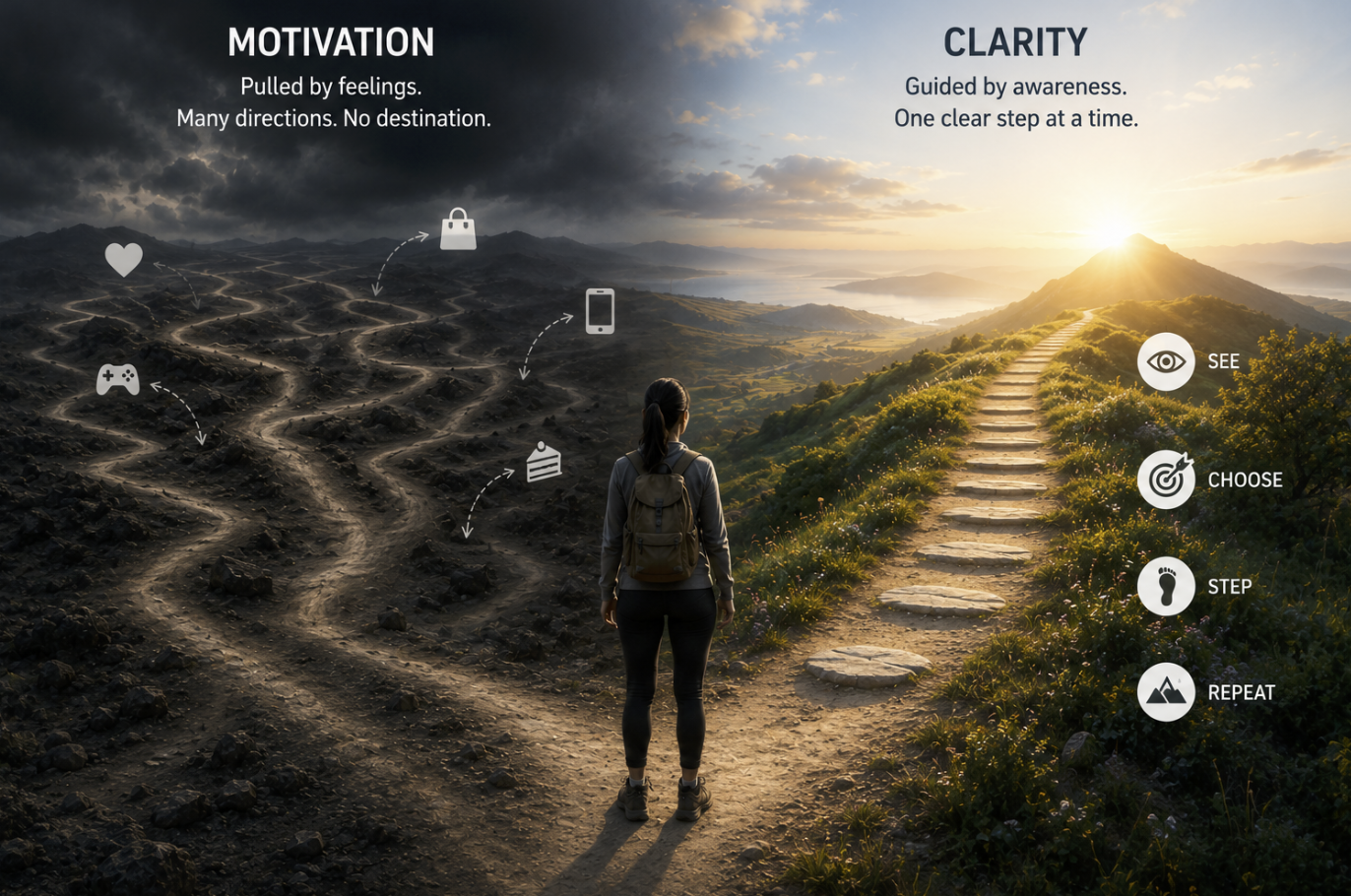
Clarity over motivation:
Many of us spend years relying almost entirely on pressure, worry, or excitement to take action. There may be another way of acting that feels quieter, more sustainable, and more deeply connected.
Motivation follows emotional attachment, while awareness follows reality.
When action depends on motivation, your direction changes whenever your emotion changes. Your path will constantly be redirected by changing emotional attachments. It follows whatever emotion is strongest in the moment.
When you act from motivation:
emotions determine where attention goes,
attention determines behavior.
When you act from awareness:
reality determines the next clear action,
behavior is guided by what is actually needed, not by what feels most attractive or least threatening.
Aligned Action changes the source of guidance—from fluctuating emotional pull to awareness of reality.
How One Tiny, Complete Act Can Change an Entire Life
One small, complete act:
→ Less unnecessary mental occupation
→ More awareness available to reality = greater clarity and sensitivity
→ Appropriate ways, possibilities, or appreciations naturally reveal
→ Appropriate response emerges = better outcome
→ A different life energy unfolds
One complete, clean act trains complete attention. Complete attention gradually becomes your default way of participating in life. That’s the mechanism of Aligned Action.
With a chain of clean acts, your field of awareness gradually opens and stabilizes: you’ll taste a new level of energy, clarity, and stability. This becomes a great “buffer” to your daily life.
You’ll be surprised to see that what actually opens the field is your care for one small, full act (not results). Stay with the chain long enough, and new energy may reveal itself.
We often spend much of our lives seeking satisfaction from what we receive (results, or consumptions) Aligned Action helps us rediscover a quieter form of satisfaction that emerges from wholehearted participation in what we're doing.
A Complete Act Begins with This Recognition
The most important moment is the one you are living right now, It’s the only moment where you can “taste” life. It’s the only moment where anything can be learned, created, or changed. Whatever you want to do with your life, you can only do it in this tiny moment called the presence.
In that sense, what you’re doing right now becomes your most important thing in this moment. It can be: writing an email, cutting carrots, crossing the street, having a conversation, or working on an “important” project.
So, whether the task is ordinary or extraordinary, this moment is always a “golden” moment. Once you see this, a complete act is no longer something you try to achieve. It becomes the natural expression of recognizing the preciousness of this moment. You ever want to miss it.
For Whom?
The practice is especially helpful for self-directed people who are living in this condition: High freedom + high responsibility + unclear or overwhelm next steps.
You may ask: How do I stay clear when life becomes more complicated?
The method is designed for moments when someone feels pressure around an important task.
If you’re experiencing either pain comes from not acting or pain comes from acting without clarity, like rushed act,
If you experience enough that relying on pressure or last-minute adrenaline to act is no longer sustainable, Aligned Action is for the moment when forcing yourself no longer works.
If you spend much of your time thinking about important work, creating something new, or moving important projects forward but struggle to consistently access clarity and take the next meaningful action,
this method is for you.
The Problem
If you're a creator, entrepreneur, coach, or self-directed professional, your challenge is rarely a lack of things to do.
The challenge is often the opposite. You have too many possibilities. Too many priorities. Too many decisions competing for your attention.
We don't usually fail because we lack motivation or discipline. We fail because our attention expands beyond the scope required for the next action.
Say, you sit down to work on something important.
Then:
Possibilities compete, thoughts multiply.
Clarity decreases.
Uncertainty, pressure, anxiety begins to build.
The project starts to feel bigger than it is.
Action becomes difficult, delay occurs.
Most people attack Stage 5 (forcing action).
Aligned Action intervenes around Stages 1–4.
It shifts the state from which behavior arises. It helps you regain contact with the reality of the situation, access clarity amidst the noise, and discover the next small, clear action.
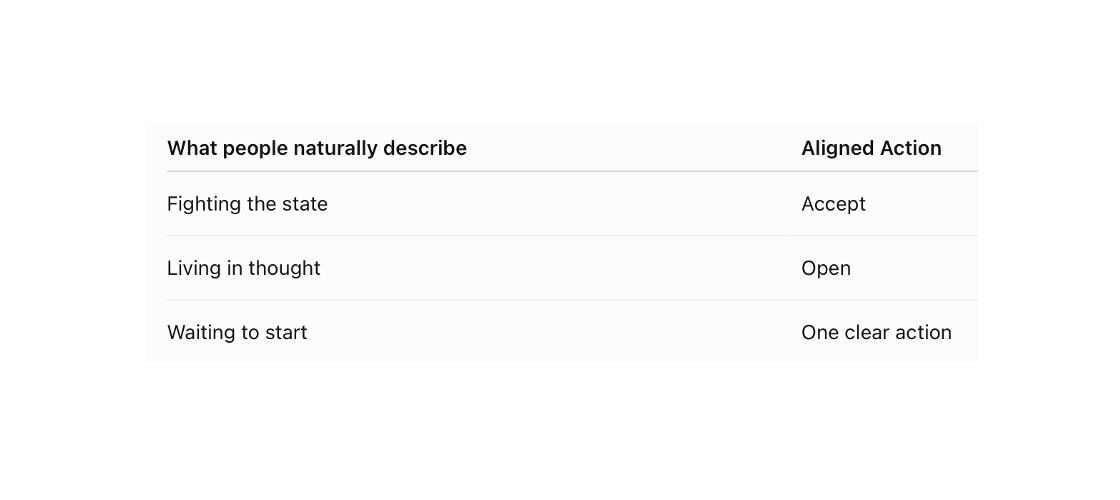
We can train our mind to restore the appropriate scope of attention in under a minute with the 3 steps of Aligned Action.
The 3 Steps of Aligned Action
A complete act already contains:
Acceptance
Awareness (Seeing).
Action
1. ACCEPT Your Current State
Notice your current state—anxiety, fatigue, confusion, resistance, pressure, restlessness—and allow it to be here. Simply acknowledge: "Given the situation, it makes sense that I feel this way."
The goal is not to become calm. The goal is to stop creating a second layer of struggle on top of what is already present. Your attention is free from fighting your internal state.
The friction at the beginning is actually a good start. It’s exactly when awareness activates and energy opens—when we accept the friction. When resistance drops, energy becomes available again.
2. OPEN Your Awareness (Seeing)
Open your awareness to the reality of the situation, or the objects involved in the task. For example: The screen, the document, the person in front of you, or whatever relevant. Let the flashlight of awareness gently illuminating everything that is part of the task.
For some tasks, opening to the reality of the task also means reconnecting with its meaning: Why does this task matter? What opportunity does it represent? Is this something I once genuinely wanted?
Return to direct experience. See what emerges.
When we see more of reality, our actions naturally become more aligned with reality. The quality of our actions depends on the quality of our perception. We don't act according to reality. We act according to the reality we perceive.
As awareness expands:
Resistance becomes one object in awareness instead of the whole experience.
Many things become visible: The task, the resources, the opportunities, the people cooperating with you.
Small next actions also become visible.
A beautiful analogy is being in a dark room. If someone turns on a light, they didn't create the furniture. The furniture was already there. The light revealed it.
Open awareness functions like that light.
3. START One Small, Clear Action
Take action on what you see.
If still unclear, ask from a wider, clearer awareness,
"What is the smallest clean action I can take right now to move this situation forward?"
Not a perfect action. Not the entire plan.
Just the one clear step: Open the document and look at it. Write a draft. Make a list.
The smaller and clearer the action, the easier it is to begin. And once you begin, something surprising often happens: the next step becomes visible.
When you notice “This act felt whole.”, you’re doing a complete act. You stop carrying the next ten steps while taking this one.
Clarity naturally emerges through this small, complete action.
So, whenever you feel hesitant and hear: “I’ll start tomorrow”:
Accept.
Open (See).
Start small.
Observe what happens.
Those 3 steps are also the 3 components of a complete action. When you meet this moment completely, you already accept what is, open to seeing, and take action on what you see.
So: When you're overwhelmed, don't try to think your way to clarity. Learn how to access clarity through one small, complete act.
Example of Applying Aligned Action to your daily situation:
Say, someone did something that disturbs your mind very much.
Your chest tightens. Your breathing becomes shallow.
Your nervous system has taken over. Your next action has already been determined.
Nobody chose anything.
One conditioning activated another. Like dominoes.
The interruption of Aligned Action:
Step 1 — Accept
You don't accept their behavior.
You accept this fact: "Right now my system is disturbed."
That is. No blame. No justification.
Instead of becoming the disturbance... you become aware of it.
Already, something changes.
Step 2 — Open
Instead of staying inside the anger with interpretations and arguments...
awareness expands.
You don't analyze the anger. You don't replace it with positive thinking.
You open awareness. You begin noticing: the room, the sounds, the chair, the space itself.
Where is the anger? It is still there.
But now it occupies perhaps 5% of experience instead of 100%.
Awareness has become larger than the wave. Disturbance is like a wave.
Instead of standing inside the wave, you stand on the shore watching the wave by open awareness. The wave no longer determines your next movement. Your seeing decides. That is what allows Step 3—a clean act—to arise.
Step 3 — One Clean Act
What is the next clean act?
So, Accept reduces resistance, Open restores direct contact with reality, and One clean act expresses that contact in action.
With Aligned Action practice, your difficult situation enriches the practice in some way. Gradually, we stop wishing things to be different. Sunny and rainy days both have their own beauties.
The Aligned Action Game
If you want to experience the visible effect of a chain of Aligned Action, this game is for you.
Choose an activity that naturally involves repetition or continuity.
For example: solving 10 math problems or working through a test, taking a run, swimming, typing, coding, reading, or even cooking.
For the best experiment, choose something you can stay with for at least 15–20 minutes. A chain gives you more opportunity to notice what changes than a single act.
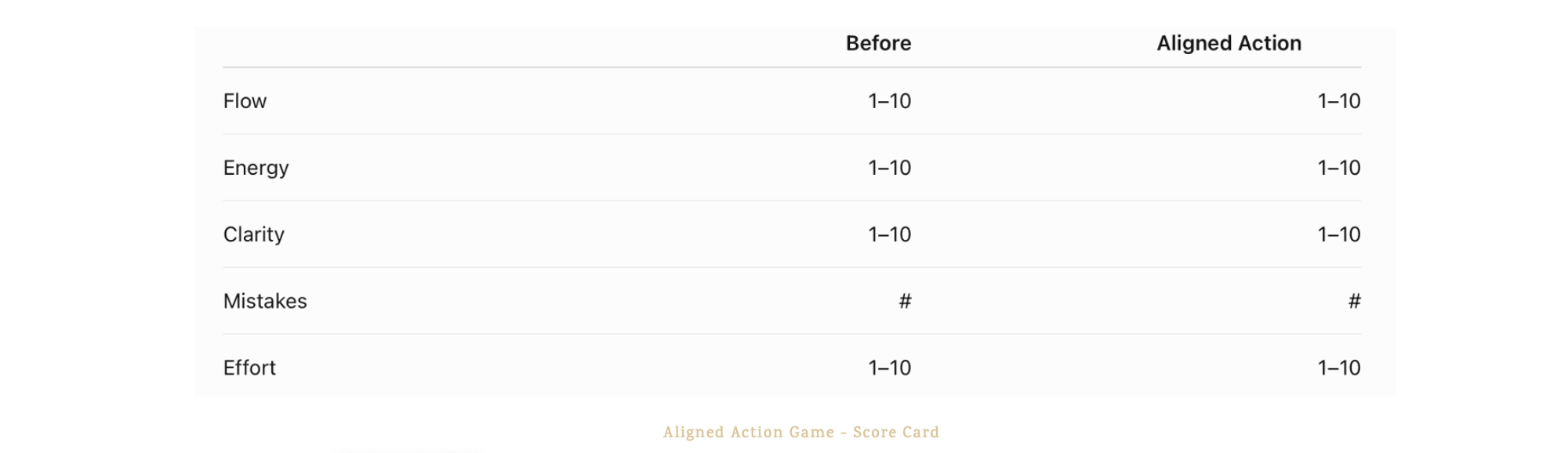
Try it once in your usual way. Then try a similar activity using Aligned Action: One small, full act. Then, one more small, full act…
Afterward, compare the two experiences. You can use the score card below.
The most important question to ask yourself is: Did you feel as if you were pushing the activity forward, or as if the field of activity was carrying you forward?
The 3 Values of Aligned Action
1. Recover Faster
"When overwhelm arises, I can recover quickly and take the next clear step.”
Instead of staying stuck in stress, distraction, or overthinking, you learn to recognize it quickly and return to a clearer, grounded state. The feeling of "I'm back." returns more quickly.
Aligned Action has a transformative potential, because it becomes a way you meet each moment—alignment.
Stress disappears when you care more about doing this action—the action in front of you—cleanly, instead of results. Stress is often the attempt to carry the whole result while taking the next step. Presence appears when you put down the result and give yourself fully to the step. (The future result gives a direction, while presence carries the action)
2. Act More Effortlessly
"I consistently do what matters, as I no longer spend an hour battling my mind before beginning important work.”
Overwhelm fragments attention—our attention gets pulled in many directions: future outcomes, past mistakes, self-judgement, competing priorities, etc. Our attention is no longer organized around the action we’re trying to take.
Aligned Action restores attention to where it is most useful for effective action: the action you’re doing right now. Taking the next step becomes easier, with greater ease. You have more enjoyment in the action itself.
You don't have to force concentration. The action itself organizes attention. One clear action gives attention a home. When attention has a home, overwhelm begins to dissolve and focus is built naturally.
Within days to weeks, you experience more meaningful progress with less mental struggle. You start important tasks more consistently. You make better decisions with less mental struggle.
3. Live More Fully
"Life itself becomes more direct, alive, and meaningful because I'm no longer living primarily in resistance."
You stop missing life. With a full, complete act, you participate so fully in this act that you no longer postpone living until some future result arrives.
Try and see it for yourself: A series of small, complete, whole acts changes the quality of your entire day. From surviving each day to enjoying it. You have more energy because less attention is wasted on internal conflict. You experience calm under pressure and trust in your ability to meet each moment.
As awareness and action become integrated, work feels more natural, life becomes more meaningful, and you experience greater peace, energy, and fulfillment—not just better results.
The longterm consequence is not only better outcomes—it is a more enjoyable way of living. And you may experience the deepest reward is not pleasure but aliveness.
How Aligned Action is Different from Productivity Methods
Some action systems are based on willpower or force. Not necessarily harsh force, but still force.
Examples:
Set a timer.
Hold yourself accountable.
Reward yourself.
Break the task into smaller pieces.
Build discipline.
Push through discomfort.
All of these can work. But the underlying relationship is often:
“I don’t want to do this, but I’m going to make myself do it.”
The inner division remains: One part pushes, another part resists.
Aligned Action explores another source of action: Presence (awareness), instead of force.
Through this approach, resistance is not something to overcome, but something to understand and include.
By doing so, you can open awareness, reconnecting with reality and allowing the next action to emerge. You access a source of clarity that force cannot provide. From that clarity, action becomes more natural (correct action revealed) and sustainable.
The result is not merely getting things done, but experiencing action as more alive, whole, full and fulfilling.
The difference is: How does the action feel?
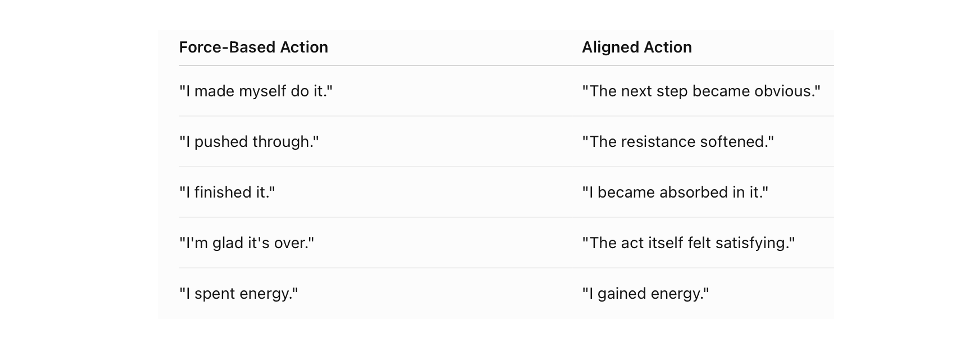
A person who acts through force often reaches the result but remains depleted.
A person who acts through presence often discovers that the act itself becomes a source of clarity, energy, and a sense of fulfillment.
The Present Act Becomes the New Measure
We often measure an action by its future outcome.
Will this succeed?
Will this make me happy?
Will people approve?
Action becomes future-oriented. Our attention leaves what we are doing and moves toward what we hope to achieve. The mind becomes pressured, fragmented, and resistant. As a result, the action itself often becomes rushed, mechanical, and incomplete.
Aligned Action introduces a new measure:
“Is this a clean, complete act?”
Action becomes present-oriented.
The question itself immediately returns attention to the present. Instead of carrying the whole project, tomorrow's deadline, or the fear of failure, attention returns to the present act. You temporarily release the future result.
This doesn't mean the result no longer matters. The ultimate purpose remains the same: to write a meaningful book, build a successful business, help a client, or complete an important project. What changes is the purpose of this moment.
Example:
Instead of writing a paragraph to finish the book, you write this paragraph as one complete act: For these few moments, the book no longer exists psychologically. Neither do the readers, the deadline, nor the fear of success or failure. There is only this sentence, this word, this thought taking shape.
Your attention rests with what is actually happening—the keyboard beneath your fingers, the ideas unfolding, the sentence becoming clearer. You are no longer trying to reach the end of the book. The future remains the destination, but it is no longer the measure of the present step.
When the measure shifts from the future result to the quality of the present act, something profound begins to change. Attention naturally comes home to what you are doing. Consciousness becomes quieter, clearer, and more unified. Action becomes more intelligent, responsive, and complete. This often leads to better results.
A complete act also contains its own reward. Instead of postponing satisfaction until the project is finished, you begin to discover a quiet sense of fulfillment within the action itself.
This new measure is not a rule to follow. It is a natural consequence of recognizing a simple fact: Life is only ever lived in this moment.
When that is clearly seen, the most meaningful question is no longer,
"Will this get me the result?"
It becomes: "What would a clean, complete act look like here?"
So the mantra is: "I don't care about results for now. I only care about making this step clean."
The 3 Stages of Aligned Action Practice
The practice continues to reveal new layers of value without changing its essence (one small, complete act)
Stage 1 — Relief
"This helps me get started when I'm overwhelmed."
Stage 2 — Discovery
"This changes how I work."
Stage 3 — Transformation
"This changes how I participate in life."
Aligned Action gradually shifts the source of your life from conditioning to awareness.
Practicing Aligned Action is like planting a young tree with a deep root system.
Today, the visible tree is small: It helps you move from overwhelm to small, clear action.
But beneath the surface is a root that reaches much deeper. As you continue practicing, you’ll discover that the same simple practice not only helps you work better, but changes how you participate in conversations, relationships, creativity, and eventually life itself.

What People Experience
Greater ease starting important work
A sense of satisfaction from action itself
Less internal resistance. More clarity. More energy
Notice these are experiences, not promises.
About the Creator

For years, I believed I had to choose between ambition and inner peace.
I’ve tried both extremes.
For many years, I pursued ambitious goals through media and entrepreneurship. Along the way, I experienced stress, setbacks, and eventually burnout. It’s like I was going with a high speed without a stable foundation.
Later, I stepped away from that path and immersed myself in Zen and Vipassana meditation. I spent three years living and training full-time at a Zen center in Cambridge, Massachusetts.
One path encouraged me to strive. The other taught me how to be. Yet neither felt complete. Something was still missing.
During the pandemic, I went through one of the most difficult periods of my life. However, I began noticing something unexpected: Whenever I stopped trying to force myself and simply open to one small, complete act, something changed. The action became smoother, and the next act became clearer.
At the same time, I began discovering the surprising power of small, clear, continuous actions. I even called it "the magical process." And here is the most important part of it: just keep coming back to tackle the same issue a little more; a breakthrough then follows.
I stopped burning out — not because I gave up ambition. I stopped burning out because I discovered a different way of acting that can be very fulfilling.
Over the years, I distilled what proved most reliable into a simple, practical method that can be applied to work, relationships, creativity, learning, and everyday life. I now call this practice Aligned Action.
My hope is not simply to help you get more done. It is to help you discover, through your own experience, a quieter and more sustainable source of clarity, energy, and action that is always available.
Looking forward to discussing the practice with you.
Linh Nguyen
Invitation
Find Your Aligned Action Reflection Index (AARI)
AARI helps you evaluate how aligned your action with reality is. It also helps you recognize the conditions that allow alignment to emerge.
Try the 3-Day Aligned Action Experience
Join a 3-day experiment designed to help you gain clarity and take meaningful action on something you've been putting off.
The process takes just 5–10 minutes per day.