What If the Strongest Energy Is the Subtlest?
What if the secret to sustaining an action is discovering a different quality of energy altogether?
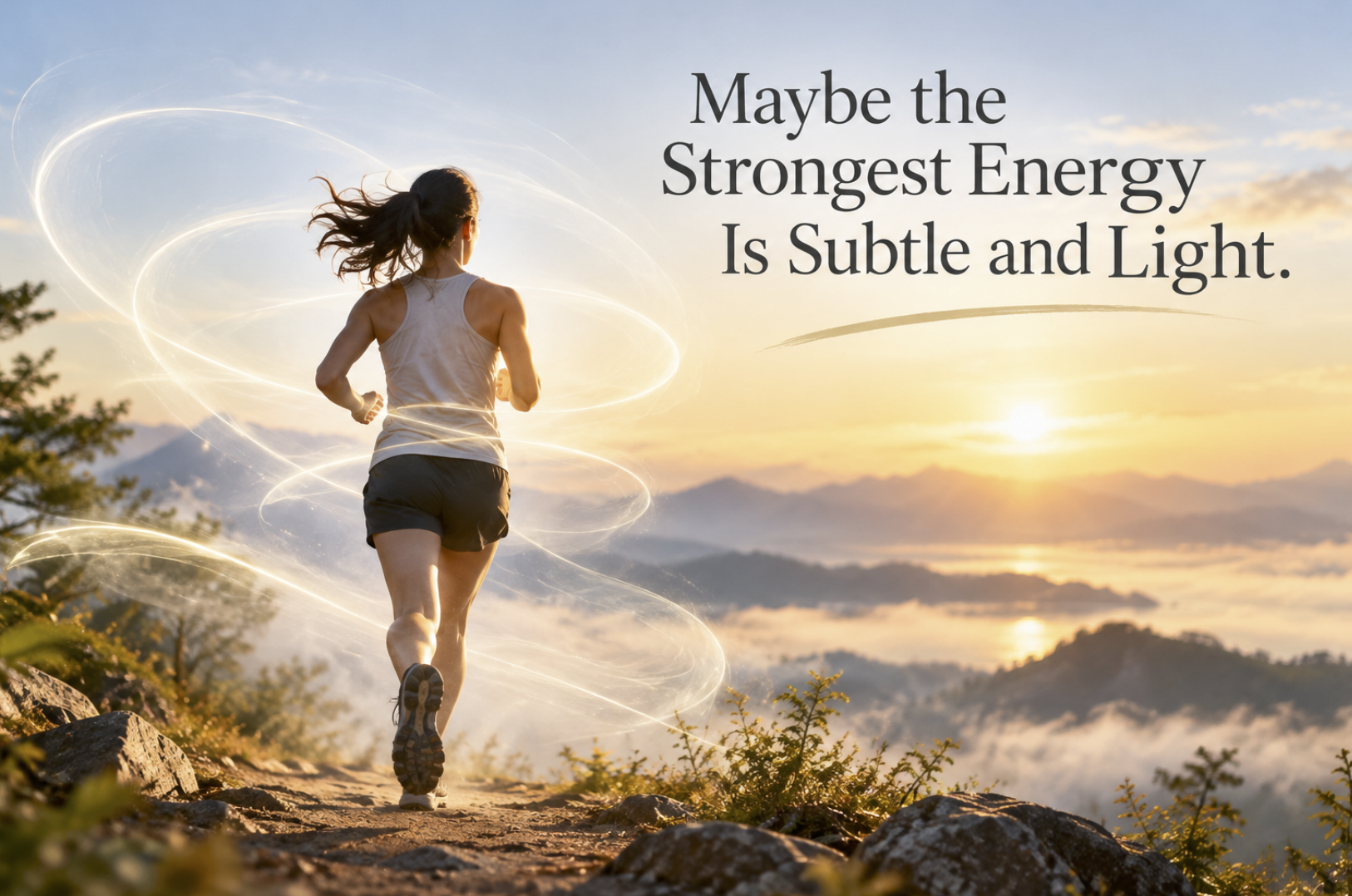
I've been exploring this question through something I've experienced while running and holding yoga poses. I call it the lightness.
It's difficult to describe until you've experienced it yourself. But once I find it, the way I experience movement changes remarkably.
My body feels lighter. The effort of controlling and carrying my body seems to diminish. Movement becomes more fluid, and I can sometimes sustain an activity for much longer than I would have expected.
The most interesting part is that I don't deliberately manufacture this lightness. It emerges spontaneously when my attention settles deeply enough.
Let me explain.
The Morning I Discovered a Different Way of Running
One morning, I was running when an amazing idea came to mind. I became so excited that I could feel the enthusiastic energy buzzing throughout my body. My mind immediately began playing a continuous movie of how the idea would become reality.
I was enjoying the excitement, but something else was happening.
After about ten minutes, my right knee started hurting. My breathing became uneven, and my legs felt heavy. Although my mind was running ahead with the happy story, my body was struggling to keep up.
I decided to step out of the story and return my attention to the present experience.
I brought my attention to my breathing. With each inhale, I swung my arms exactly three times: left, right, left. With each exhale, I relaxed the counting.
Gradually, my mind quieted.
Then I noticed something subtle. A spaciousness seemed to open in front of me, while also extending around and within my body. My breathing became deeper, my belly and lungs moved more freely, and my body began to feel lighter.
Eventually, my running changed.
Instead of feeling as though I had to push my body forward, my movement became fluid. The thinking that had previously pulled me into an imagined future seemed to settle into a quiet space that supported my movement.
I felt as though I could run forever.
Of course, I couldn't literally run forever. But the experience of effort had changed so profoundly that continuing felt surprisingly natural.
The Lightness Isn't Something I Have to Create
I've since noticed a pattern.
The quality of lightness seems to depend partly on how deeply my attention settles and partly on the physical condition of my body.
When my attention is scattered, absorbed in thoughts, or constantly anticipating what comes next, I find it harder to access this experience. When my attention becomes more focused and settled, the lightness can emerge spontaneously.
I don't have to tell myself to feel light. I don't have to imagine that my body is floating. I simply become attentive, and something seems to open.
When it does, I experience two changes simultaneously.
First, my body feels physically lighter, almost as though gravity has less psychological weight.
Second, the effort of controlling and carrying my body seems to diminish. I don't feel the same need to consciously manage every movement. Running becomes more fluid. Holding a yoga pose can feel surprisingly sustainable.
There are plausible physical explanations for some of these effects. Settled attention can influence perceived effort, and improved coordination or reduced unnecessary muscular tension may make movement feel easier. The feeling of lightness, however, doesn't by itself establish that the body is using less energy or that a new physical force has appeared.
What I know directly is the experience. Understanding its full nature is a separate inquiry.
A Spaciousness That Seems to Hold Both Me and the World
There's another aspect of this experience that fascinates me even more.
The lightness doesn't feel as though it originates exclusively inside my body. It feels as though I'm resting in something spacious that exists both around me and within me.
Sometimes, my body seems to be supported by this space. Sometimes, it feels as though my body is moving within a vast, quiet field that is more fundamental to my experience than the stream of thoughts in my mind.
And sometimes, there's a sense that movement can unfold without my having to consciously direct everything.
These descriptions are difficult to separate because they seem to arise together.
I experience the body becoming lighter, the effort of control diminishing, and the surrounding spaciousness becoming more apparent.
Could these be different aspects of the same experience?
I don't yet know.
But the experience has made me curious about something beyond ordinary physical relaxation.
What Might the Masters Say About This?
I find interesting parallels in several contemplative traditions.
In Taoism, the principle of wu wei points toward action without unnecessary forcing. Water finds its way through openings rather than fighting every obstacle. The idea isn't simply to do nothing, but to act without imposing unnecessary struggle.
Laozi is describing the Tao as something that may seem elusive or unimpressive to the senses, yet is inexhaustible in its application. A subtle quality can reveal extraordinary possibilities through practice. These lines are from Chapter 35 of the Tao Te Ching:
“Look at it and there is not enough to see; listen to it and there is not enough to hear; use it and it is inexhaustible.”
In Buddhist meditation, pīti describes an uplifting quality of energy or joy that can accompany concentration. Some practitioners report sensations of bodily lightness, buoyancy, and increased vitality.
In Advaita Vedanta and other nondual traditions, practitioners investigate awareness beyond the ordinary identification with the individual body and mind. The distinction between the observer, the observed, and the experience itself becomes a subject of inquiry.
These teachings offer different ways to explore experiences that may resemble aspects of what I've encountered. They shouldn't be treated as proof that all these traditions describe the same phenomenon, or that my experience has a particular spiritual cause.
Could the spaciousness I experience be related to what some traditions describe as universal consciousness, vital energy, or a deeper intelligence?
That's a question I'm open to exploring.
But I don't want to rush to a conclusion simply because a spiritual explanation feels compelling. I'd rather remain attentive to the experience itself and investigate what it reveals.
The Body Still Has Its Limits
One important distinction has emerged from my running experience.
When the body is tired, I may still be able to run as usual after entering the lightness. The run can feel manageable even when the body needs substantial rest and nutrition afterward.
When my body is healthy and well recovered, however, I can return from a run and continue working normally, feeling healthy and energized.
This reminds me that the experience of effort and the body's physical needs aren't necessarily the same thing.
Feeling light doesn't guarantee that the body is free from strain. Feeling capable of continuing doesn't mean that recovery is unnecessary.
The physical condition of the body still matters. So do sleep, nutrition, hydration, and appropriate recovery.
The lightness may change how I experience and coordinate an action, but I cannot assume that it eliminates the physiological cost of that action.
For me, this is a reason to investigate the experience more carefully, not a reason to dismiss it.
From Lightness to the Presence Ball
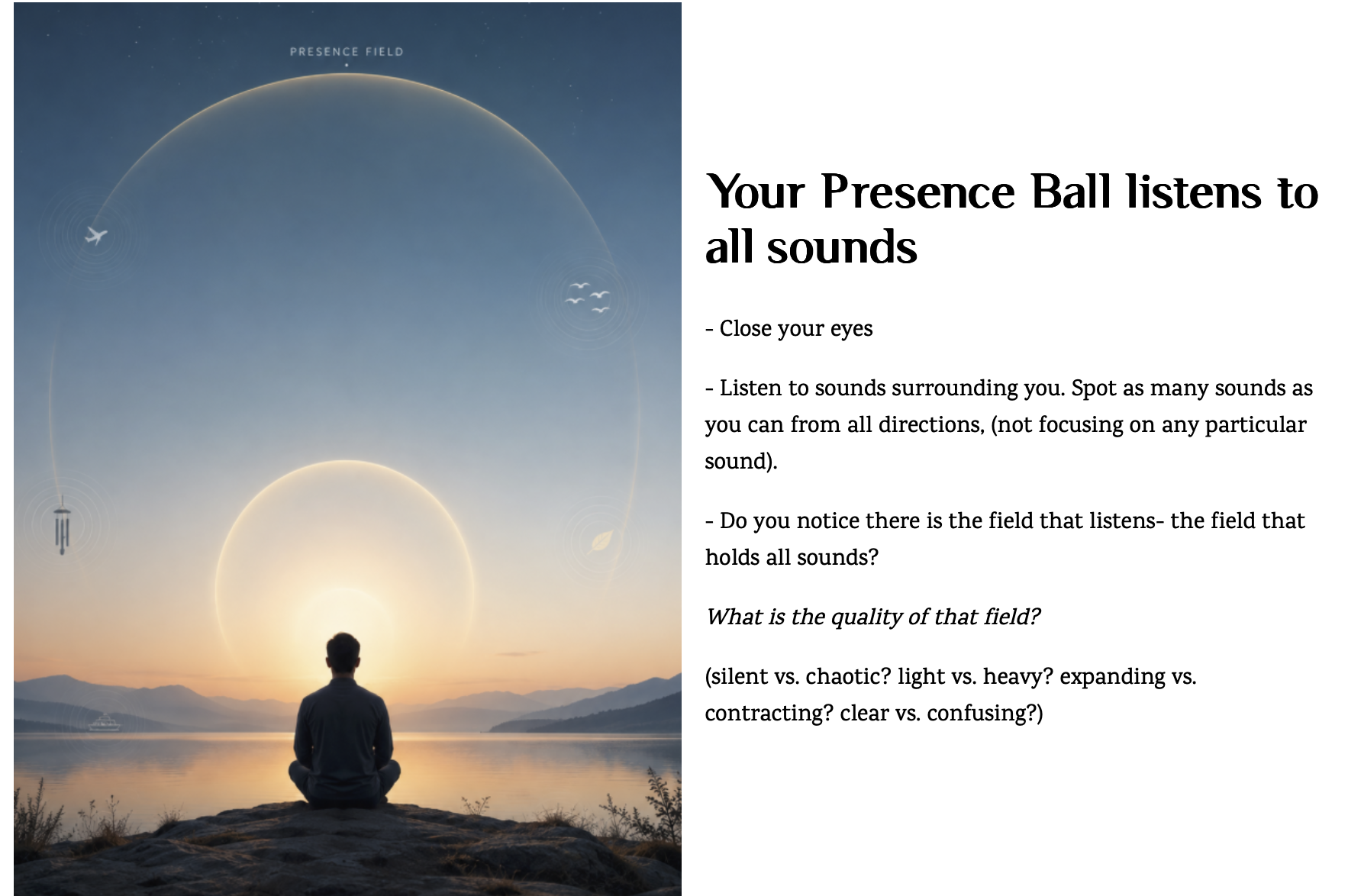
This experience connects with a concept I've been developing called the Presence Ball.
I use this term to describe a tangible way of exploring a spacious field of presence that seems to include both the body and its surroundings.
Rather than concentrating narrowly on an object, a problem, or a physical task, I open my awareness to include the space around me and within me. I allow attention to settle instead of constantly directing it through deliberate thought.
Sometimes, a quality of lightness emerges.
I can then continue the activity while resting in that experience, rather than continually trying to manufacture motivation or force the next movement.
The Presence Ball is my name for this way of exploring presence. (You can read more about it at the end of the article.) Whether the experience corresponds to a distinct energy field in the physical sense is an open question; the term describes my experiential framework, not an established scientific entity.
What interests me is whether this way of attending can be cultivated and applied beyond physical movement.
Could the same principle help when writing, solving a difficult problem, or beginning something I've been resisting?
Could I learn to enter a state in which attention becomes spacious, unnecessary mental interference diminishes, and action becomes more natural?
These are questions I want to investigate through direct experience.
The Second Body: A Different Foundation for Action
This exploration also connects with the central idea behind my work on The Second Body.
We often assume that to accomplish more, we must generate more motivation, exert more willpower, or push ourselves harder.
Sometimes we do need to make an effort. But perhaps effort isn't the only variable we can change.
What if we could learn to act from a different foundation?
Instead of relying entirely on the mind's stream of thoughts, judgments, plans, and expectations, we might discover a way of acting from a more settled, spacious awareness.
I don't mean that thinking is unnecessary or that every action will become effortless. Thinking, planning, physical conditioning, and deliberate practice remain important.
I'm exploring a different possibility: that the quality of attention from which we act can change our experience of the action itself.
This is where I see a connection with Aligned Action. Rather than trying to overcome every internal obstacle through pressure and willpower, we learn to acknowledge our current state, open our awareness, and take the next action from a more present and less entangled state.
The lightness I've experienced while running offers me a tangible starting point for this investigation.
I can feel the difference between pushing myself forward through mental excitement and moving from a state in which attention, breathing, and movement seem to work together.
I don't yet have a complete explanation for what happens. But I have something worth investigating: a repeatable experience that invites me to explore the relationship between attention, effort, and action.
How about you?
Have you ever experienced a moment when your body or an action seemed to become unexpectedly light and effortless—not because you forced yourself harder, but because something in your experience changed?
I'd love to hear what happened and how you understand it.
For more reading about a way to discover the Presence Ball: